


QTO — For over 50 years, the Medisch Comité Nederland – Vietnam (MCNV) has left an indelible mark on Quang Tri through countlessly impactful projects. On the occasion of launching a new project to support women of ethnic minority in Huong Lap and Huong Phung communes, the Quang Tri Newspaper, Radio and Television conducts an interview with Mr. Pham Dung, Chief of MCNV Representative Office in Vietnam.
Women in Huong Phung commune receive training in sustainable forestry (supported by MCNV). Photo: MCNV
Empowering Women
Question (Q): Recently, a project titled “Promoting sustainable livelihoods to improve food security for poor ethnic minority women in Quang Tri province” (the PRO-POOR project) was launched by MCNV. Could you tell us more about this initiative?
Answer (A): The PRO-POOR project is funded by MCNV and implemented in partnership with the Quang Tri Department of Foreign Affairs. Spanning 36 months in Huong Lap and Huong Phung communes, it has a total budget of €600,000 (roughly 18 billion VND). Our goal is to improve livelihoods, boost incomes, and enhance food security for poor ethnic minority women—ultimately lifting the overall quality of life across Quang Tri’s mountainous communities.
Q: What inspired MCNV to put ethnic minority women at the heart of this project?
A: Ethnic minority women bear the heaviest burden of poverty, food insecurity, and climate change. Yet, they play a vital role in keeping family finances afloat and nourishing the next generation. Our field surveys in Huong Lap and Huong Phung showed that women are not only primary breadwinners, but they also carry the major share of household chores and caregiving duties.
Despite their critical role, they face steep hurdles in accessing capital, agricultural training, and market information, and they rarely have a seat at the table when key family or community decisions are made.
At MCNV, we firmly believe that investing in women is one of the most effective ways to break the cycle of poverty. When women gain the knowledge, skills, and resources to build sustainable livelihoods, they gain a stronger voice in financial decisions at home—leading to greater investment in their children’s health, education, and nutrition.
These positive changes don’t stop at the doorstep; they ripple across the whole community. That is why PRO-POOR aims to do more than just boost incomes—it strives to elevate women’s leadership, position, and influence in local economic development.
Decades of Steadfast Support
Q:PRO-POOR isn’t a standalone project; it’s a part of MCNV’s nearly 60-year journey with Quang Tri. Looking back, what stand out to you as MCNV’s most meaningful contributions?
A: For MCNV, PRO-POOR is not just a project—it is the hallmark of a relentless, 50-plus-year journey alongside Quang Tri.
MCNV was founded in 1968 by a group of Dutch doctors driven to provide medical relief to war-affected Vietnamese people. Our connection with Quang Tri officially began in 1974, marked by helping the province build its very first general hospital.
Since 1990, we have deepened this collaboration through a wide array of programs in healthcare, education, social inclusion, and community development. While we support communities as a whole, we prioritize vulnerable and marginalized groups—specifically persons with disabilities, people living in poverty, ethnic minorities, women, and children.
What truly defines MCNV’s work is our commitment to capacity building. We focus on passing down skills and empowering local leaders and communities, ensuring residents are actively involved in planning, implementing, and reviewing development activities. Thanks to this approach, many project models continue to thrive long after our project ends.
In recent years, MCNV has spearheaded several impactful programs in Quang Tri, such as the PROSPER project, which promotes sustainable forest management and builds strong partnerships among forest owners, local communities, and businesses.
Another vital initiative is the U.S. government-funded “Inclusion” project, designed to improve the quality of life for people with disabilities affected by Agent Orange. Beyond these, we actively run various programs aimed at building sustainable livelihoods and self-reliance in ethnic minority communities.
Q: Few people realize that most of MCNV’s long-standing funding doesn’t come from massive institutions, but from individual donations by ordinary Dutch citizens. What message does this humanitarian aid carry to the people of Quang Tri?
A: The backbone of MCNV’s work in Vietnam—and in Quang Tri specifically—comes from the generosity of thousands of Dutch people. Many of them have stood by MCNV since the wartime.
Some still donate 3 to 5 Euros every month out of their modest pensions. These contributions may seem small on paper, but sustained over generations, they represent an enormous well of goodwill toward hardship-stricken communities in Vietnam.
The message the Dutch people send to Quang Tri is simple: “Distance can never lessen human empathy.” They believe everyone deserves a chance to live a healthy life, earn a reliable living, and look forward to a better tomorrow. That shared belief has forged a bond between the kindhearted in the Netherlands and the people of Quang Tri for over half a century, and MCNV is deeply honored to be the bridge connecting them.
Being there for the most vulnerable
Q: Would you say the compassion of the Dutch people defines MCNV’s compass of action—to always be present in the toughest places and stand beside those who need it most?
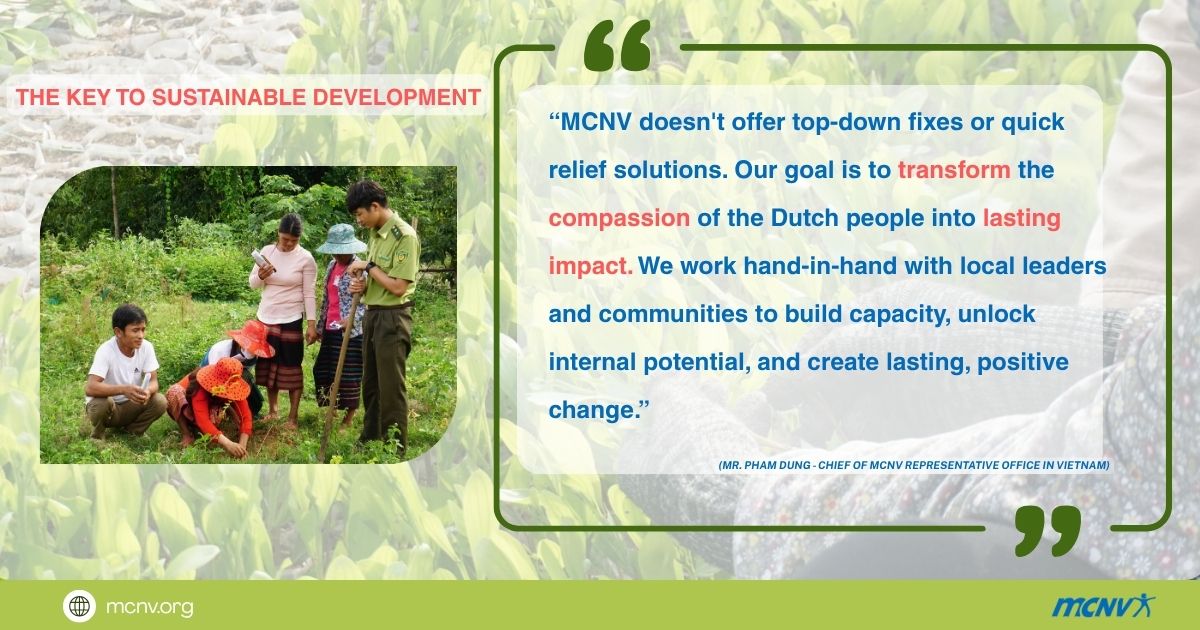
A: Absolutely. MCNV doesn’t offer top-down fixes or quick relief solutions. Our goal is to transform the compassion of the Dutch people into lasting impact. We work hand-in-hand with local leaders and communities to build capacity, unlock internal potential, and create lasting, positive change.
People are at the center of everything we do, with priority always given to the most vulnerable: the poor, women, children, people with disabilities, and ethnic minorities. This is clear in our work across Quang Tri. We deliberately choose to focus on remote, mountainous areas where development opportunities are scarce and communities suffer most from poverty and climate change.
After more than 50 years, MCNV remains deeply committed to Quang Tri. We believe true sustainable development only happens when the most vulnerable among us have the opportunity to participate, benefit, and thrive alongside their community.
Q: As Quang Tri enters a new phase of growth with fresh challenges, how is MCNV preparing to support the province in the years ahead?
A: Moving forward, we are committed to staying the course with Quang Tri through two key priorities:
– Promoting sustainable, climate-resilient livelihoods: Helping local people—especially women and ethnic minorities—boost their income while safeguarding local natural resources, forests, and the environment.
– Investing in the people: Improving community nutrition, boosting local skill sets, advancing gender equity, and giving marginalized groups a stronger voice in the course of development. Alongside this, MCNV will continue tapping into new networks to bring fresh development opportunities to the region.
To MCNV, Quang Tri is far more than a project site—it is a lifelong partner. Having walked together for over 50 years, we are confident that this bond will grow even stronger as we build healthier, more prosperous, and resilient communities ready to face whatever the future holds./.
(Translated from original article: https://baoquangtri.vn/xa-hoi/202608/chia-khoa-cua-su-phat-trien-ben-vung-2f37269/ – Quang Tri News, Radio and Television).


